
Dr. Nikchehre Mohseni - psyedu- دانشکده روانشناسی و علوم تربیتی
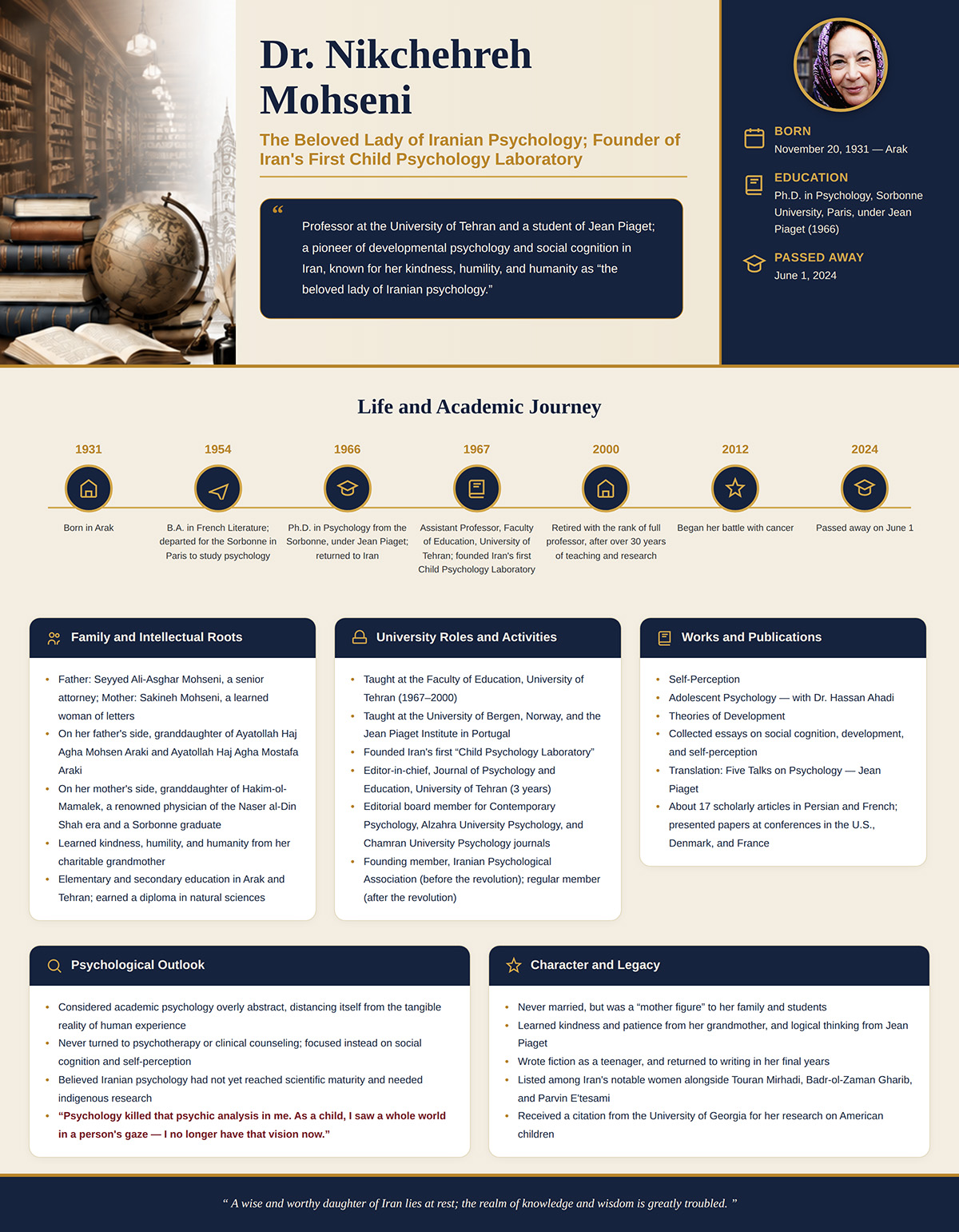
Dr. Nikchehre Mohseni (1931–2024)
“The Gentle Lady of Iranian Psychology” and Founder of the First Child Psychology Laboratory in Iran
Early Life and Family Background
Dr. Nikchehre Mohseni was born on November 19, 1931, in Arak into a distinguished and scholarly family. Her paternal lineage included two prominent Shia scholars—Grand Ayatollah Hajj Agha Mohsen Araki and Grand Ayatollah Hajj Agha Mustafa Araki. Her maternal grandfather, known as Hakim al‑Mamalik, was a renowned physician during the reign of Nasser al‑Din Shah Qajar and a graduate of the Sorbonne.
Raised in a cultured and compassionate household, Mohseni was deeply influenced by her grandmother, a pious and charitable woman whose kindness shaped her worldview. Her father, Seyyed Ali Asghar Mohseni, was a lawyer, and her mother, Sakineh Mohseni, possessed a rich memory of classical Persian poetry and moral teachings.
The family moved from Arak to Tehran to provide better educational opportunities for their daughters. Mohseni completed her schooling at Nobavgan School, Anoushirvan Dadgar High School, and Nourbakhsh High School, earning a diploma in natural sciences.
Education and Academic Formation
Initially aspiring to become a lawyer, Mohseni changed direction due to social constraints of the time. She briefly considered medicine but ultimately chose French literature at the University of Tehran, graduating in 1954.
Driven by a profound interest in human nature, she traveled to Paris to study psychology at the Sorbonne University, where she completed her doctoral dissertation under the supervision of Jean Piaget, one of the most influential psychologists of the 20th century.
She returned to Iran in 1966 and began teaching, eventually joining the Faculty of Educational Sciences at the University of Tehran in 1967 as an assistant professor. She retired in 1990 with the rank of full professor after more than three decades of teaching and research.
Academic and Professional Contributions
Dr. Mohseni’s contributions to Iranian psychology are extensive and foundational:
Academic Positions and Teaching
- Professor, Faculty of Psychology and Educational Sciences, University of Tehran (1967–1990)
- Visiting professor at the University of Bergen (Norway)
- Visiting scholar at the Jean Piaget Institute of Psychology (Portugal)
- Instructor at multiple Iranian universities including Shiraz, Guilan, Al‑Zahra, Allameh, and Azad University
Institutional Leadership
- Founder of the Child Psychology Laboratory, University of Tehran
- Editor‑in‑chief, Journal of Psychology and Educational Sciences (3 years)
- Member of editorial boards of Contemporary Psychology, Al‑Zahra University Psychology Journal, and Chamran University Psychology Journal
- Founding member of the Iranian Psychological Association (pre‑revolution)
- Regular member of the Iranian Psychological Association (post‑revolution)
Research and Publications
Dr. Mohseni authored and translated influential works, including:
- Self‑Perception
- Adolescent Psychology (with Dr. Hassan Ahadi)
- Theories of Development
- Translation of Piaget’s Five Discourses of Psychology
She published approximately 17 research articles in Persian and French and presented her work at conferences in the United States, Denmark, France, and elsewhere.
She also conducted a major cross‑cultural study comparing cognitive development among urban children in Tehran, rural Iranian children, and European children.
Her research interests centered on:
- Social cognition
- Self‑perception
- Developmental psychology
- Cognitive development
She received a certificate of appreciation from the University of Georgia for her research on American children.
Psychological Perspectives
Despite her deep engagement with psychology, Mohseni was critical of the discipline’s abstract tendencies. She believed that academic psychology often distances scholars from the lived reality of human experience. As she stated:
“People are too complex to fit into a framework and law.”
She avoided clinical practice, feeling that counseling in its common form lacked depth and efficacy. Instead, she focused on developmental research, social cognition, and the concept of the “self,” which she believed was underrepresented in Persian psychological literature.
Her book Self‑Perception reflects her commitment to understanding identity, individuality, and the psychological foundations of human experience.
Personality, Influence, and Legacy
Beyond her academic achievements, Dr. Mohseni was widely admired for her kindness, humility, and compassion. Students and colleagues often described her as one of the kindest and most gentle figures in Iranian psychology.
She was deeply influenced by:
- Her grandmother’s generosity
- Jean Piaget’s intellectual rigor and humanistic approach
- Dr. Ali Akbar Siasi’s cultural vision and people‑centered philosophy
Her nieces regarded her as the “mother of the family,” and many of her students—now prominent psychologists—remember her as a mentor whose warmth matched her scholarly excellence.
She was honored alongside figures such as Parvin Etesami, Turan Mirhadi, and Badr‑o‑Zaman Gharib as one of the distinguished women of Markazi Province.
Final Years and Passing
After a 12‑year battle with cancer and a month of hospitalization, Dr. Nikchehre Mohseni passed away on June 12, 2024, at the age of 93.
Her niece wrote in her memory:
“The wise and valuable daughter of Iran is asleep; the assembly of knowledge and science is deeply saddened.”
Her legacy endures through her students, her writings, and her pioneering contributions to developmental psychology and child research in Iran.