
Dr. Abbas Horri - psyedu- دانشکده روانشناسی و علوم تربیتی
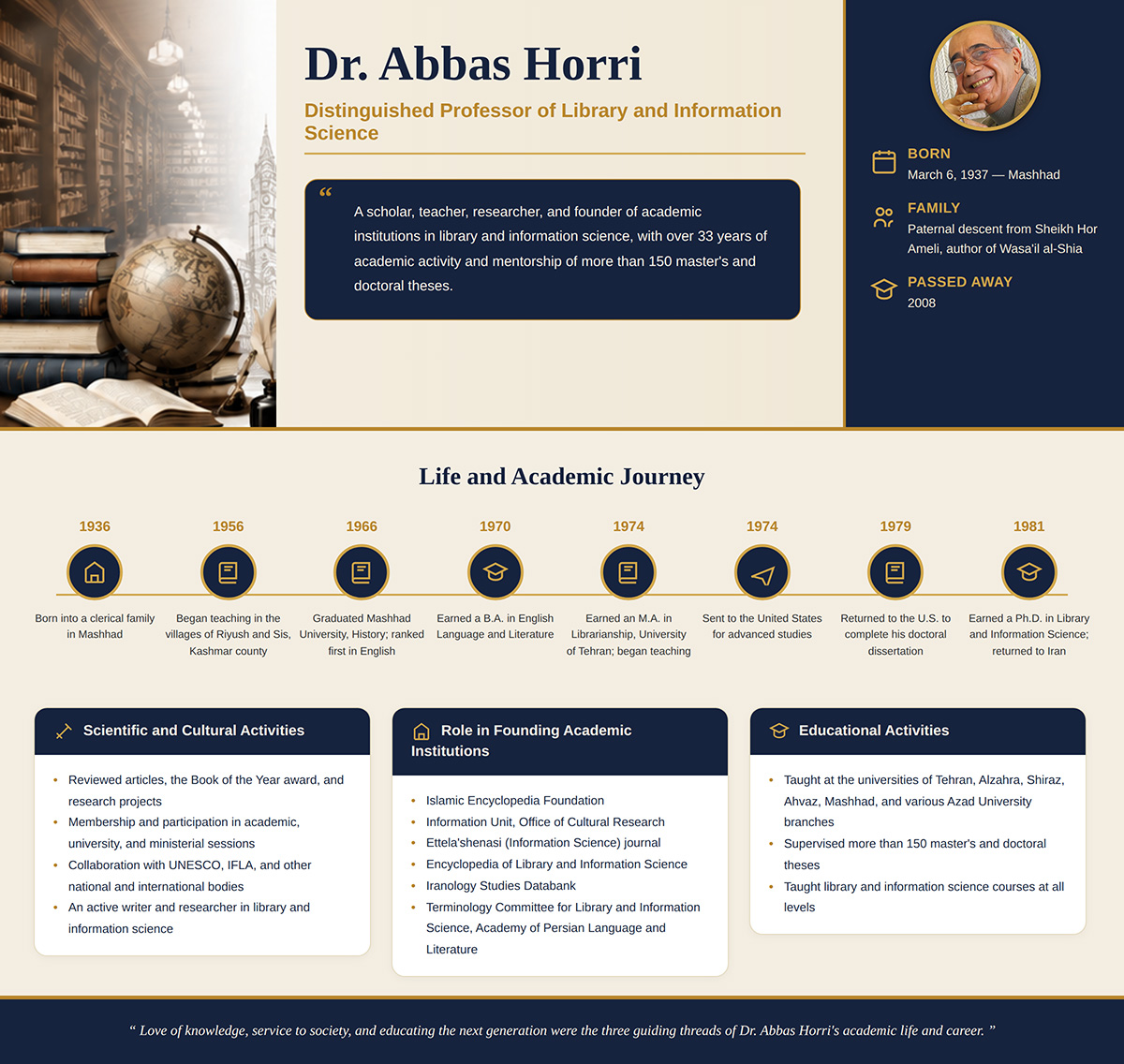
Dr. Abbas Hari (Harri) , Pioneer of Library and Information Science in Iran
Dr. Abbas Hari (Harri) was born on March 15, 1936, in Mashhad into a respected clerical family. His paternal lineage traces back to Sheikh Hurr Ameli, the renowned 11th‑century Shia scholar and author of Wasa’il al‑Shi‘a. His family was of modest economic means, yet deeply rooted in religious scholarship and community leadership. His father was widely trusted as a mediator in social and familial disputes and passed away in 1963; his mother died a few years later.
Hari spent his childhood in a semi‑religious school environment and developed an early familiarity with classical texts through his father’s library. His formative years coincided with wartime hardship, shaping his understanding of social conditions and resilience.
Education
Hari’s educational trajectory reflects both perseverance and intellectual ambition:
- Completed primary and secondary schooling in Mashhad
- Studied for two years in a preparatory seminary
- Began teaching in rural Khorasan at age 20 (1956)
- Completed his high‑school diploma while teaching
- Earned a B.A. in English Language and Literature from Mashhad University (1968)
- Earned an M.A. in Library Science from the University of Tehran (1973)
- Completed a Ph.D. in Library and Information Science at Case Western Reserve University (1981), with a dissertation on citation similarity and index‑term similarity in subject linkage of documents
He completed the coursework for his doctorate in just fourteen months, spending nearly all his time in the university library.
Academic and Professional Career
After joining the University of Tehran in 1974, Dr. Hari became one of the foundational figures in modern Iranian librarianship and information science. His career includes:
Academic Positions
- Instructor and later professor, Faculty of Psychology and Educational Sciences, University of Tehran
- Faculty member at Islamic Azad University (Science and Research Branch)
- Teacher at multiple universities across Iran (Tehran, Mashhad, Shiraz, Ahvaz, Al‑Zahra, Tarbiat Modares)
Administrative and Leadership Roles
- Secretary, Iranian Librarians Association (1973–1975)
- Member, Children’s Book Council (from 1973)
- Head of Student Affairs, Faculty of Psychology and Educational Sciences (1975–1977)
- Director, Information Department, Islamic Encyclopedia Foundation (1986–1991)
- Director, Editorial Department, Amir Kabir Publications (1986–1991)
- Deputy Director for Research, National Library of Iran (1993–2000)
- Member, Asia‑Pacific Regional Committee of IFLA (from 1993)
- President, Iranian Science Promotion Association (from 2005)
- Member, Supreme Council for Information (1997–2005)
- Member, Editorial Boards of multiple national and international journals
He supervised more than 150 master’s and doctoral theses and taught for over 33 years.
Foundational Contributions
Dr. Hari played a central role in establishing major scientific and cultural institutions in Iran, including:
- Islamic Encyclopedia Foundation
- Information Unit of the Cultural Research Office
- Information Unit of the Islamic Encyclopedia Foundation
- Journal of Informatics
- Encyclopedia of Librarianship and Information Science
- Iranology Studies Bank
- Terminology Committee for Librarianship and Information (Academy of Persian Language and Literature)
He also served as editor‑in‑chief of several journals, including Journal of Librarianship, Journal of Information Science, and Pol‑e Firouzeh.
Scholarly Interests and Theoretical Contributions
Dr. Hari was deeply engaged in theorizing information science, particularly from the 1980s onward. His intellectual interests included:
- Mathematical theory of information
- Semantic theory
- Cybernetic theory
- Quantum theory of information
- Information ecology
- Information potential difference
- Methodology of information science
He also wrote on:
- Popper’s “Third World”
- Ibn Khaldun’s theory of authorship
- Foundations of citation analysis in Islamic and Western scholarship
These contributions positioned him as one of the earliest Iranian theorists in information science.
Publications and Editorial Work
Dr. Hari authored numerous articles and books, including:
- The Code of Scientific Writing (selected as an academic book of the year, 2001)
- Review of Information and Informatics (Book of the Year of the Islamic Republic of Iran, 2003)
He also contributed to encyclopedias, thesauri, and major national reference works.
Awards and Honors
- Honored as a Pioneer Professor by the Iranian Library and Information Society and the University of Tehran
- Recipient of multiple national awards for scholarly books
- Honored by the Cultural Heritage and Honors Association on his 70th birthday (2006), marking 40 years of scientific service
Personal Life
Dr. Hari married in 1963 and had two sons, both graduates of the University of Tehran in medicine and dentistry. His family endured significant hardships with patience and resilience, which he often acknowledged with gratitude.
Death
Dr. Abbas Hari passed away on May 27, 2013, at the age of 77. His legacy continues through his students, his theoretical contributions, and the institutions he helped build.