
Dr. Gholamhossein Shokouhi - psyedu- دانشکده روانشناسی و علوم تربیتی
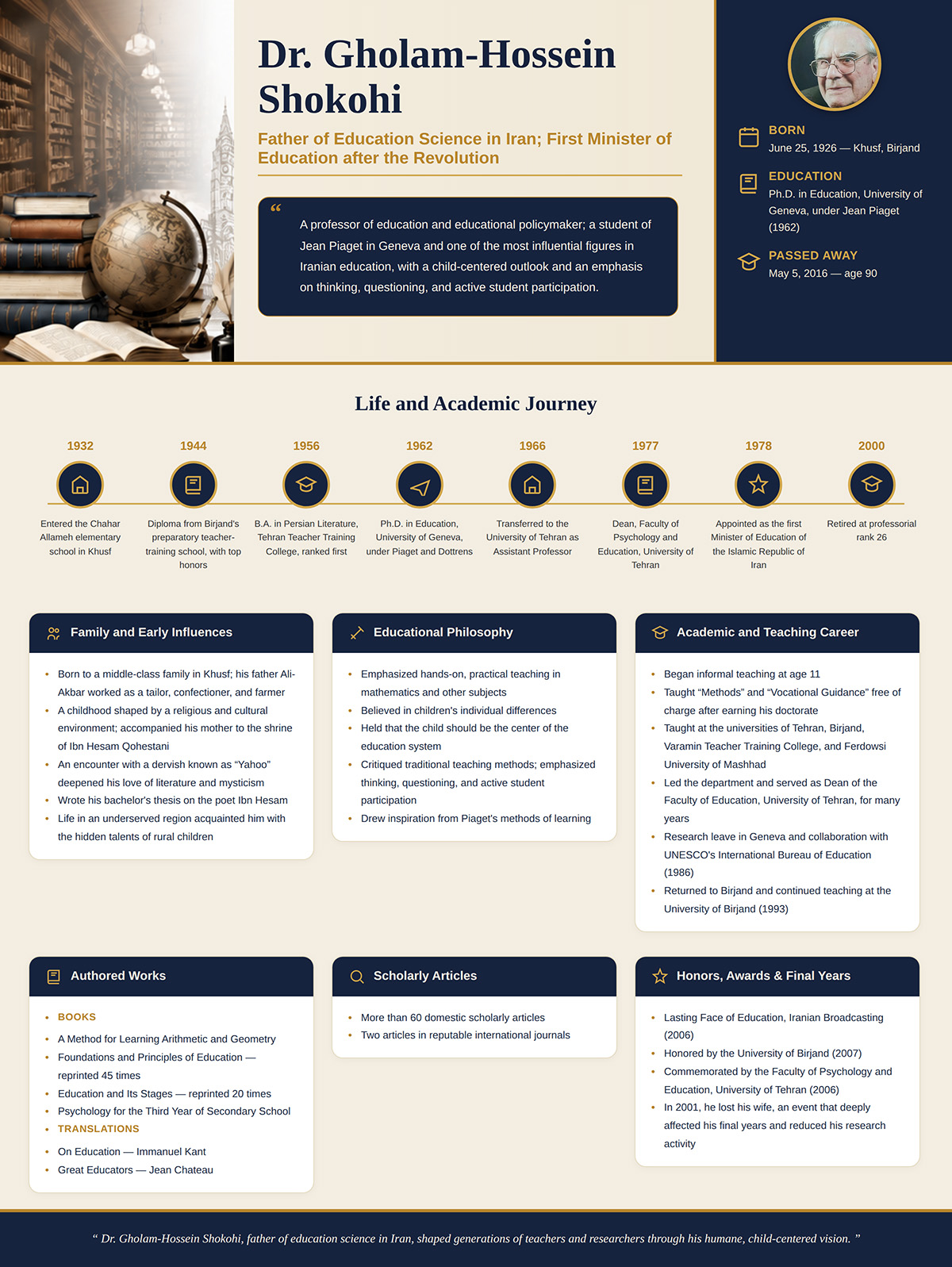
Dr. Gholamhossein Shokouhi , Father of Iranian Education and First Minister of Education of the Islamic Republic of Iran
Dr. Gholamhossein Shokouhi (born July 22, 1926, Khusf – died May 16, 2016) was one of the most influential Iranian scholars in educational sciences and a pioneering figure in modern teacher education. He was born into a modest middle‑class family in Khusf, a suburb of Birjand. His father worked as a tailor and confectioner and struggled to provide for the family, yet deeply valued education.
Shokouhi’s childhood was shaped by religious and cultural influences, particularly the shrine of the 9th‑century poet Ibn Hesam, located in his hometown. His mother, who raised him with great care, frequently took him to this shrine, which later inspired his undergraduate thesis on Ibn Hesam.
Education
Shokouhi began his schooling at Chahar Allameh Elementary School in Khusf in 1932. After completing primary school, he continued his education in Birjand, where he lived independently from the age of 12 due to his father’s death.
His academic achievements include:
- Diploma from Birjand Preparatory College (1944)
- Full Diploma in Literature (1948)
- B.A. in Elementary Education, Higher School of Education, Tehran (1956)
- Doctorate in Educational Sciences, University of Geneva (1962), Jean‑Jacques Rousseau Institute
- Additional diplomas in educational sciences and vocational guidance
He studied under renowned scholars such as Jean Piaget, whose influence shaped his lifelong commitment to child‑centered education.
Early Teaching Career
Shokouhi began teaching informally at age 11, assisting his former school principal. After completing preparatory school, he taught in rural villages around Khusf and Birjand. His early teaching experiences deeply shaped his educational philosophy, particularly his belief in recognizing individual differences among children.
One of his most famous memories involves a gifted student, Gholamhossein Haqdad, who ingeniously calculated the height of a tree using shadow ratios—a story Shokouhi often cited as evidence of the hidden talents in deprived regions.
Academic and Professional Career
After earning his doctorate in Geneva, Shokouhi returned to Iran in 1962 and began working in the Ministry of Culture’s Educational Studies Office (later the General Directorate of Studies and Programs). He gradually entered academia and became one of the foundational figures of the Faculty of Educational Sciences at the University of Tehran.
Positions Held
- Assistant Professor, Associate Professor, and Full Professor, University of Tehran (1966–1993)
- Dean, Faculty of Educational Sciences, University of Tehran
- Head of Department, Faculty of Educational Sciences
- First Minister of Education of the Islamic Republic of Iran (1978, Interim Government)
- Chairman, Higher Education Council (four‑year term)
- Visiting Scholar, International Bureau of Education (UNESCO), Geneva (1986)
- Professor, Birjand University (after 1993)
He continued teaching for 57 years, retiring in 1999 with the rank of “Professor Grade 26,” yet remained academically active until the death of his wife in 2002.
Educational Philosophy
Shokouhi was a strong advocate of child‑centered education, emphasizing:
- Recognition of individual differences
- Practical, hands‑on learning
- Encouraging children to think rather than memorize
- Allowing students time to explore ideas independently
He frequently cited Piaget’s method of responding to children’s questions with:
“What do you think?”
—believing that true learning emerges from reflection, not repetition.
He criticized the Iranian education system for its haste, overemphasis on exams, and lack of meaningful learning.
Dr. Shokouhi authored and translated numerous influential works, including:
Authored Books
- Method of Learning Arithmetic and Geometry
- Fundamentals of the Principles of Education (45+ reprints)
- Education and Training and Its Stages (20+ reprints)
- Psychology for Third‑Year Secondary Education (1988)
Translations
- Education and Training by Emmanuel Kant
- Great Teachers by Jean Chano
He published over 60 articles in Iranian scientific journals and two articles in international journals.
Personal Life
Shokouhi married Safra Sareh, a classmate from Switzerland who later authored The Active Kindergarten Method. Her death in 2002 deeply affected him, leading to a decline in his academic activity. He suffered a mild stroke two years later but regained speech and mobility through perseverance.
He had two sons, both graduates of the University of Tehran in medicine and dentistry.
Honors and Recognition
- Recognized as a “Lasting Figure in Iranian Education” (2006)
- Honored by Birjand University (2007)
- Memorial ceremony held by the Faculty of Psychology and Educational Sciences, University of Tehran (2006)
Death
Dr. Gholamhossein Shokouhi passed away on May 16, 2016, at the age of 90. He is remembered as one of the most influential educators in modern Iranian history and a foundational figure in the development of educational sciences in Iran.