
Dr Kardan - psyedu- دانشکده روانشناسی و علوم تربیتی
Ali Mohammad Kardan
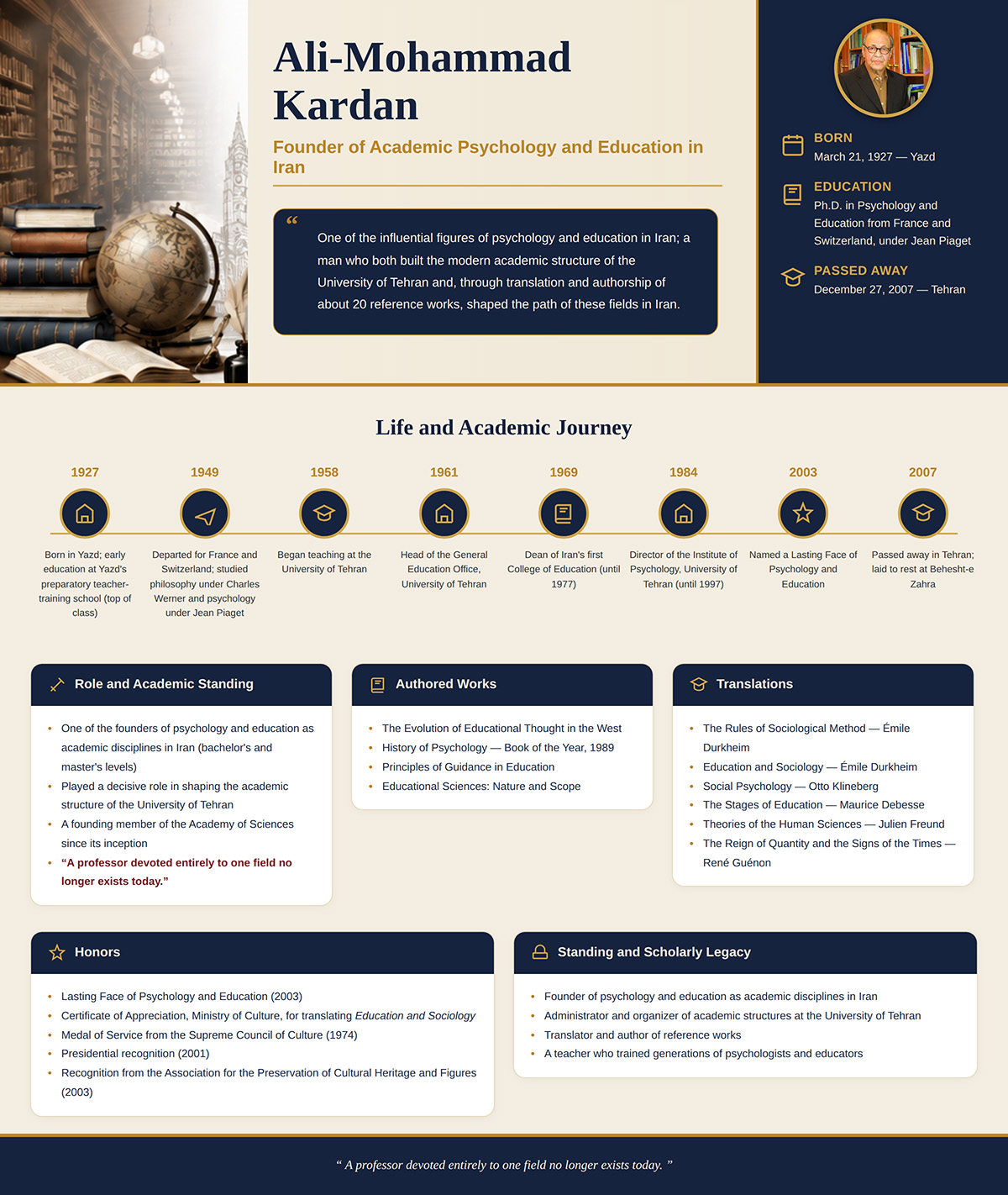
Ali Mohammad Kardan (April 1, 1927, Yazd – January 27, 1987, Tehran) was a prominent Iranian scholar in the fields of education and psychology. He was a full member of the Academy of Sciences of the Islamic Republic of Iran and was recognized in 2003 as one of the “Eternal Figures” (Chehre-ye Mandegar) in psychology and educational sciences. Kardan also served as the head of the Institute of Psychology at the University of Tehran and as the dean of the Faculty of Educational Sciences.
Kardan completed his primary and secondary education in Yazd and, due to his outstanding academic performance, was sent to the Higher Teachers’ College in Tehran at government expense. He studied Persian literature under renowned scholars such as Mohammad Moin, Parviz Khanlari, and Badi’ al-Zaman Forouzanfar, and Arabic under Mehdi Elahi Ghomshe’i. He also studied ancient philosophy with Mohammad Hossein Fazel Tuni and was a contemporary of Yahya Mahdavi, Rezazadeh Shafaq, and Gholam Hossein Seddighi.
In 1949, he traveled to France and later to Switzerland to pursue advanced studies. In France, he studied philosophy with Charles Werner and psychology with Jean Piaget, ultimately earning his doctorate. He also attended courses in psychology taught by Ali Akbar Siasiyya, in educational sciences by Mohammad Bagher Hoshyar, Isa Seddiq, and Asadollah Bijan, and in physiology by Abdollah Sheibani.
Upon returning to Iran, Kardan joined the University of Tehran as a faculty member. In 1962, he was appointed Director General of Education at the University of Tehran, and from 1969 to 1977 he served as dean of the Faculty of Educational Sciences. In 1974, he received the Order of Merit from the Supreme Council of Culture. After the 1979 Revolution, he continued teaching at the University of Tehran and, in 1984, became director of the Institute of Psychology, a position he held until 1987. He was honored by the President in 1980 and was later recognized by the Association of Cultural Works and Honors in 2003. Kardan passed away on January 27, 1987, and was buried in Behesht-e Zahra Cemetery.
Works and Publications
Kardan authored and translated approximately twenty works in psychology and educational sciences. His book History of Psychology was selected as the “Book of the Year” in 1989. He also received a commendation from the Ministry of Culture and Islamic Guidance for his translation of Emile Durkheim’s Sociology and Education.
His major works include:
- Rules of Sociological Method, Emile Durkheim (translator), University of Tehran
- The Reign of Quantity and the Signs of the Times, René Guénon (translator), University Publishing Center
- The Course of Educational Thought in the West, SAMT
- An Introduction to Islamic Education: Philosophy of Education (co-author), SAMT
- Social Psychology, Otto Klineberg (translator), Scientific and Cultural Publications
- Education and Sociology, Emile Durkheim (translator), University of Tehran
- Educational Sciences: Its Nature and Scope, SAMT
- Stages of Education, Maurice Debesse (translator), University of Tehran
- Theories Related to the Humanities, Julien Freund (translator), University Publishing Center
- Principles of Guidance in Education, University of Tehran
Academic and Administrative Roles
Kardan was a faculty member of the Faculty of Psychology and Educational Sciences at the University of Tehran and an active member of national and international scientific associations in sociology and educational sciences. He held several key academic positions, including:
- Director of the Institute of Social Studies and Research
- Director General of Education at the University of Tehran
- Founding dean of the first Faculty of Educational Sciences in Iran
- Director of the Institute of Psychology at the University of Tehran
- Member of the Academy of Sciences of the Islamic Republic of Iran
- Member of the Research Council of the Institute for Humanities
- Member of the Board of Auditors of the University of Tehran
Kardan was deeply concerned about the state of academic professionalism in Iranian universities. He argued that many university instructors were unable to devote themselves fully to academic work due to financial pressures and multiple employment obligations. He emphasized the importance of full-time academic commitment, which he believed had diminished over time.
Legacy
In 2003, Kardan was officially recognized as an “Eternal Figure” in psychology and educational sciences. He also received a certificate of appreciation from the Association of Cultural Works and Honors and was honored by the President in 2008. As one of the founders of undergraduate and graduate programs in psychology and educational sciences at the University of Tehran, he played a pivotal role in shaping the academic identity of these disciplines in Iran.