
Dr Dadsetan - psyedu- دانشکده روانشناسی و علوم تربیتی
Dr. Parirokh Dadestan
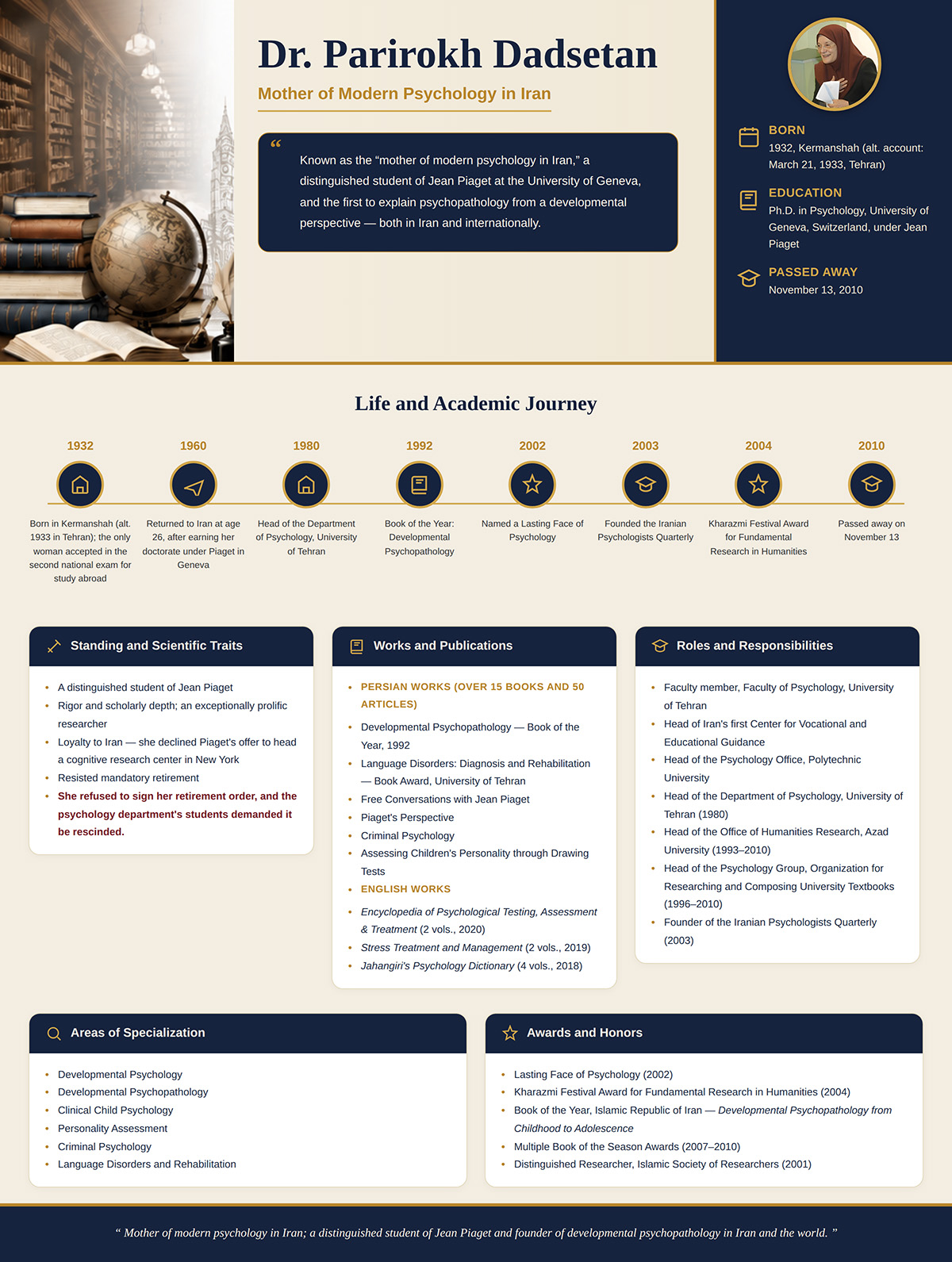
(1933–2010) was a distinguished Iranian psychologist, professor, and one of the foundational figures of modern psychology in Iran. Born on April 1, 1933, in Tehran, she completed her early education at Khorshid Elementary School and later earned academic and literary diplomas from Namus and Shahdokht High Schools. At the age of sixteen, she was the only woman accepted in the national examination for study abroad during the Pahlavi era. She subsequently traveled to Switzerland and pursued her higher education at the University of Geneva.
Her exceptional academic performance led Jean Piaget—one of the most influential developmental psychologists of the twentieth century—to accept her as his doctoral student. Piaget valued her scholarship to the extent that he offered her a position at the New York Cognitive Center, which she declined out of commitment to her homeland. She completed her PhD in psychology at the age of twenty-six and returned to Iran in 1960.
Academic Career
Upon her return, Dr. Dadestan assumed leadership of Iran’s first center for professional and academic guidance. She later directed the psychology office at the Polytechnic University under the supervision of the University of France. In 1975, at the invitation of Ali Akbar Siasi, she joined the Department of Psychology at the University of Tehran. She became an associate professor in 1979 and achieved the rank of full professor in 1986.
Dr. Dadestan taught a wide range of courses—including developmental psychology, child clinical psychology, psychopathology, personality assessment, diagnostics, and criminal psychology—at both undergraduate and graduate levels. She supervised more than 17 doctoral dissertations and over 100 master’s theses, and she served as principal investigator for more than 17 national research projects.
From 1993 to 2010, she directed the Humanities Studies and Research Office at Islamic Azad University (South Tehran Branch). Between 1997 and 2010, she also headed the Psychology Department at the Organization for Research and Compilation of Humanities Textbooks. In 2003, she co-founded the Iranian Psychologists Quarterly.
Scholarly Contributions
Dr. Dadestan is widely recognized as the “Mother of Modern Iranian Psychology.” Her work significantly shaped the language and conceptual framework of contemporary Iranian psychology. She was among the first scholars internationally to articulate psychopathology from a developmental perspective.
Her academic contributions span two major domains:
- Developmental Psychology – deeply influenced by Piaget’s genetic epistemology
- Clinical and Pathological Psychology – integrating developmental principles into clinical understanding
She translated several of Piaget’s works into Persian, and Piaget himself wrote an introduction to one of her books—an honor rarely bestowed.
Her major works include:
- 18 Articles in Psychology
- Introduction to Language Disorders: Diagnosis and Rehabilitation (selected by the University of Tehran)
- Open Conversations with Jean Piaget
- Evaluation of Children’s Personality Based on Drawing Tests
- Clinical Psychology
- Piaget’s Perspective
- Criminal Psychology
- Developmental Pathological Psychology (Book of the Year, 1992)
She authored or co-authored more than 15 books and over 50 scientific articles, and she contributed to numerous national research initiatives.
Awards and Honors
Dr. Dadestan received numerous national awards throughout her career, including:
- Book of the Year of the Islamic Republic of Iran (for Critical Psychology of Development from Childhood to Adolescence)
- Seasonal Book Awards (multiple years)
- Basic Research Award in the Humanities, 15th International Kharazmi Festival (2004)
- Recognition as an “Enduring Figure” in psychology (2002)
- Commendation as one of the best authors by the Organization for the Study and Compilation of Humanities Books
Nearly all of her research projects received awards or national recognition.
Later Years and Passing
Dr. Dadestan continued her academic and administrative work until her final years. She passed away from cancer on November 12, 2010, at the age of 77. A documentary titled Geneva–Tehran Flight was later produced to commemorate her life and contributions.